
Standard products

Automatically build standard products in SOLIDWORKS with TSFP.

Search for standard products in the TSFP catalog.

×
DIN 580

DIN 580

Bolt: lifting eye · Products: 25

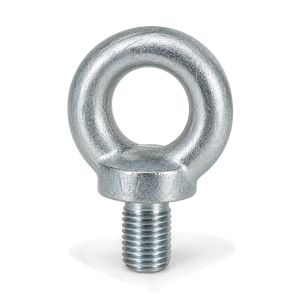
DIN 580 - Lifting eye bolts

DIN 580:2024-05 lifting eye bolts, forged in steel or stainless steel; unlike the ISO 3266 eyebolt, the standard gives the eye height h and starts at M6. The 25 sizes run from M6 to M64, then M72x6, M80x6 and M100x6. Height h runs from the seating face to the top of the eye; l is the shank length below it. WLL is the axial rating of one fully seated bolt (0.075–40 t); inclined loads require reduced ratings. ISO 3266 has separate dimensions and load ratings.
ISO 3266

ISO 3266

Bolt: lifting eye · Products: 17

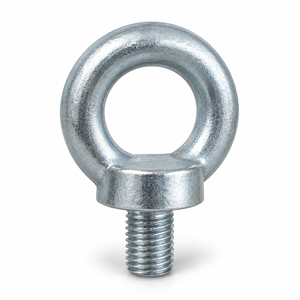
ISO 3266 - Forged steel eyebolts grade 4

Forged steel eyebolts grade 4 for general lifting purposes, forged in one piece, with the eye sized for a shackle; dimensions and working load limits differ from the DIN 580 eye bolt. The eyebolt is screwed into a tapped hole until its collar seats flat on the part, and the load is taken by the eye above the collar; a shackle of the same working load limit couples straight into that eye. A size is the thread alone: it fixes the working load limit WLL in axial loading, and the load in turn fixes the eye - the bore E that a shackle pin passes through and the section F that fits between the shackle jaws. The threaded shank H measures 1,5 d from the underside of the collar, the distance s to the first thread is a quarter of the thread diameter, and the collar B is the flat seat the part has to offer around the hole. Covers threads M8 to M64 with coarse pitch and M72x6 to M100x6 with fine pitch, with working load limits from 0,2 t to 50 t. Table 2 marks E, B and r as minimum values and F as a maximum; H and s have no min/max qualifier. H is the shank length below the seating face. The height above the seating face is not specified by ISO 3266. DIN 580 is a separate standard with its own dimensions. Grade 4 eyebolts are made for use between -20 °C and 200 °C; a pair of them may also be loaded at an angle to their axes, which lowers the load they may carry. The current text is the 2010 edition with Amendment 1 of 2015; it replaced the first edition of 1984, which rated the same threads lower and drew a larger eye for lifting hooks instead of shackles.